Categorized under 'studio news'

New Sites, New Blogs, New Year

Wednesday, January 6th, 2010

If you follow my blog, you’ve noticed that I’ve been silent here for quite some time. However, I’m not sitting on my hands! I’ve been terribly busy. In fact, I’ve created six new web sites that focus on my photographic specialties. And because of that, much of my blogging efforts have been spent on those other sites. Anyway, here are links to my new web sites. Enjoy!

Weddings – web site / blog

Portraits – web site / blog

Product / Commercial – web site / blog

Nature – web site / blog

Personal Projects – web site / blog

Fine Art – web site / blog

Sometime in the coming months I may update this original blog. In the meantime, if you’re a client looking for recent examples of my work, please check out my new sites.

Walt Disney Concert Hall Signage

Saturday, August 8th, 2009

I’ve seen hundreds of photos of Walt Disney Concert Hall in downtown Los Angeles. But I’ve never seen anyone focus on photographing this small sign located right outside the main entrance. As a Los Angeles wedding photographer, I’ve worked at the Walt Disney Concert Hall many times, but I had never noticed this sign until just the other day. And although signage isn’t mad hot sexy, I’m posting these on my blog anyway–recording them for posterity’s sake.

Walt Disney Concert Hall

Walt Disney Concert Hall

Living at the Los Angeles Brewery – Frequently Asked Questions

Sunday, July 12th, 2009

I’m often asked many questions about our Los Angeles studio. Those curious folks include clients, other photographers, neighbors, and Brewery Art Walk attendees). To answer some of those questions, I’ve developed this brief list of Frequently Asked Questions (FAQ) that I hope you’ll find helpful.

What is the Los Angeles Brewery?

Our studio is located in part of what is known as the Los Angeles Brewery Art Complex. There are exactly 300 live / work spaces located in this complex (located near downtown Los Angeles). The smallest spaces are 1,200 square feet while the largest space is 6,000 square feet. That being said, there are only a handful of studios larger than 3,000 square feet. That makes our studio one of the largest spaces on the property. This area is called “The Brewery” because many buildings on the property were once owned and operated by the Pabst Brewing Company.

What’s the history of your building?

Our studio is the found in the south facing wing of the former Southern California Edison Electric Power Station #3 building. The building was built in 1903 and is registered as a Historic Cultural Landmark by the City of Los Angeles. Our studio is rumored to be the transformer room for the original power plant.

How can I live in The Los Angeles Brewery?

Live / work spaces are rented / leased on a first come, first served basis. But before you inquire, there’s an important professional requirement if you want to live at the Brewery–you must be an artist. Some of our neighbors include photographers, painters, sculptors, metal workers, clothing designers, jewelry designers, doll makers, interior designers, belly dancers, trapeze artists, martial artists, commercial designers, graphic artists, stylists, location scouts, chefs, and illustrators. If you want to lease a space at The Brewery, call Carlson Industries frequently to inquire as to availability–typically at least once a month. The office phone number is (323) 222-3007. The typical annual turnover is only 5% so there are seldom many vacancies. Lease prices for spaces less than 3,000 square feet are typically $1.00 to $1.25 per square foot. The maximum lease length is three years. Most spaces in the Brewery are leased in roughed out condition. This typically means that you must build out your own kitchen, bathroom, storage spaces as well as provide your own means for heating and cooling the space.

How big is your studio?

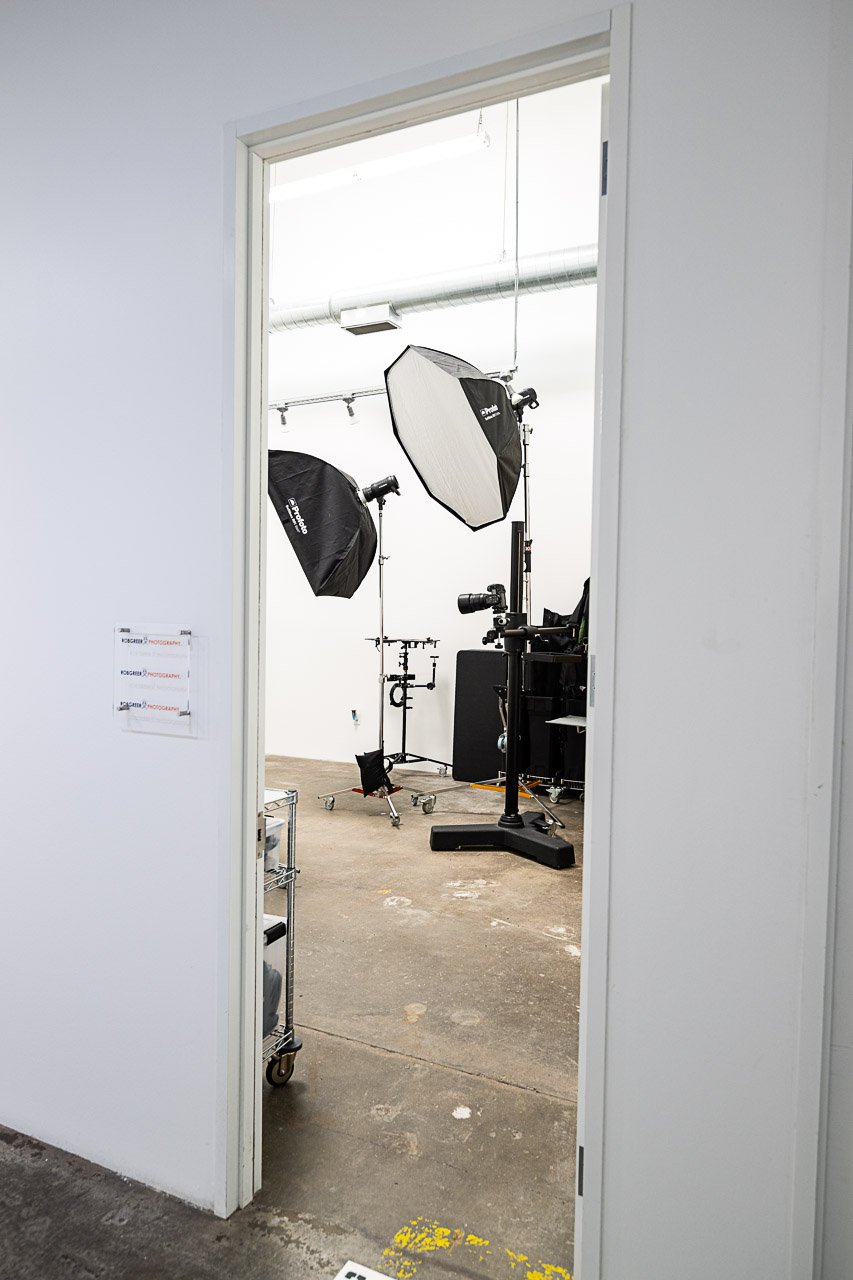
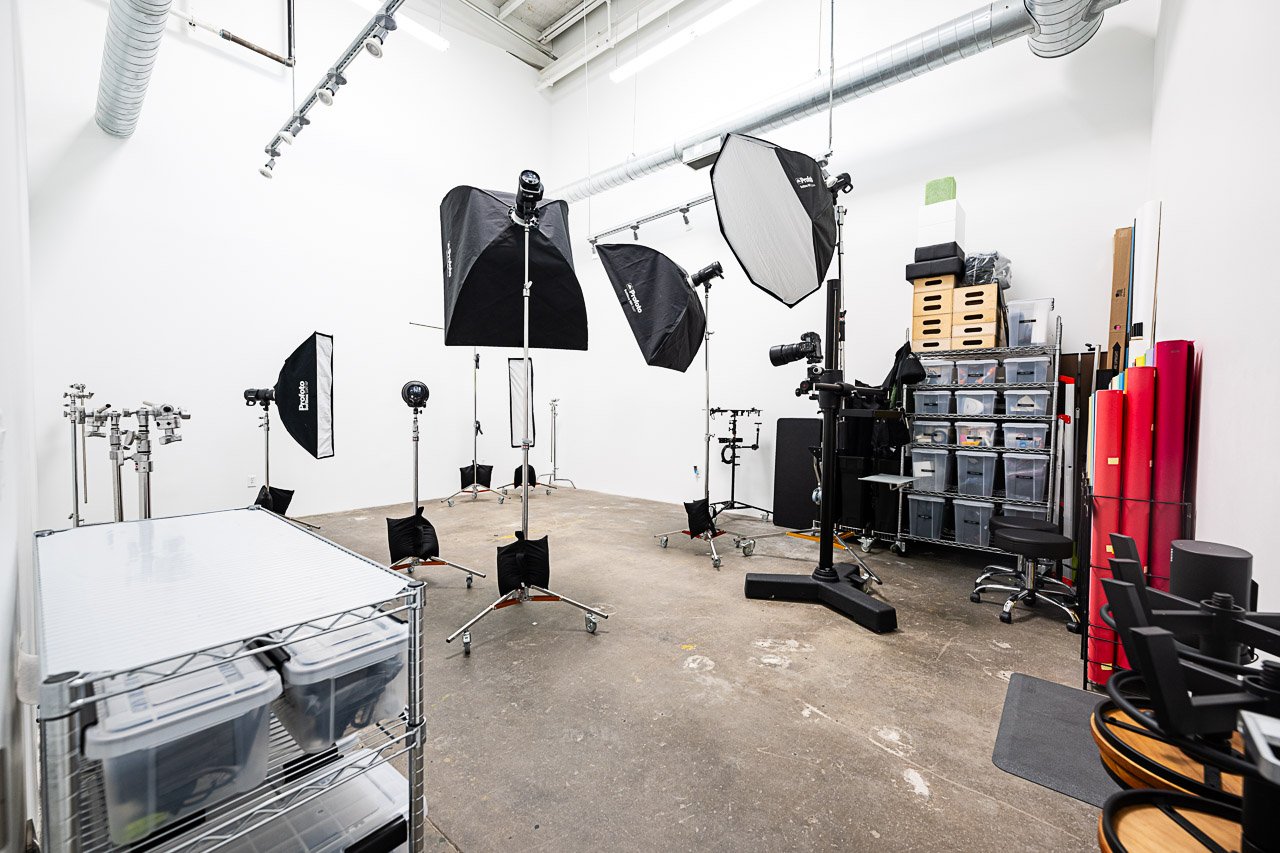
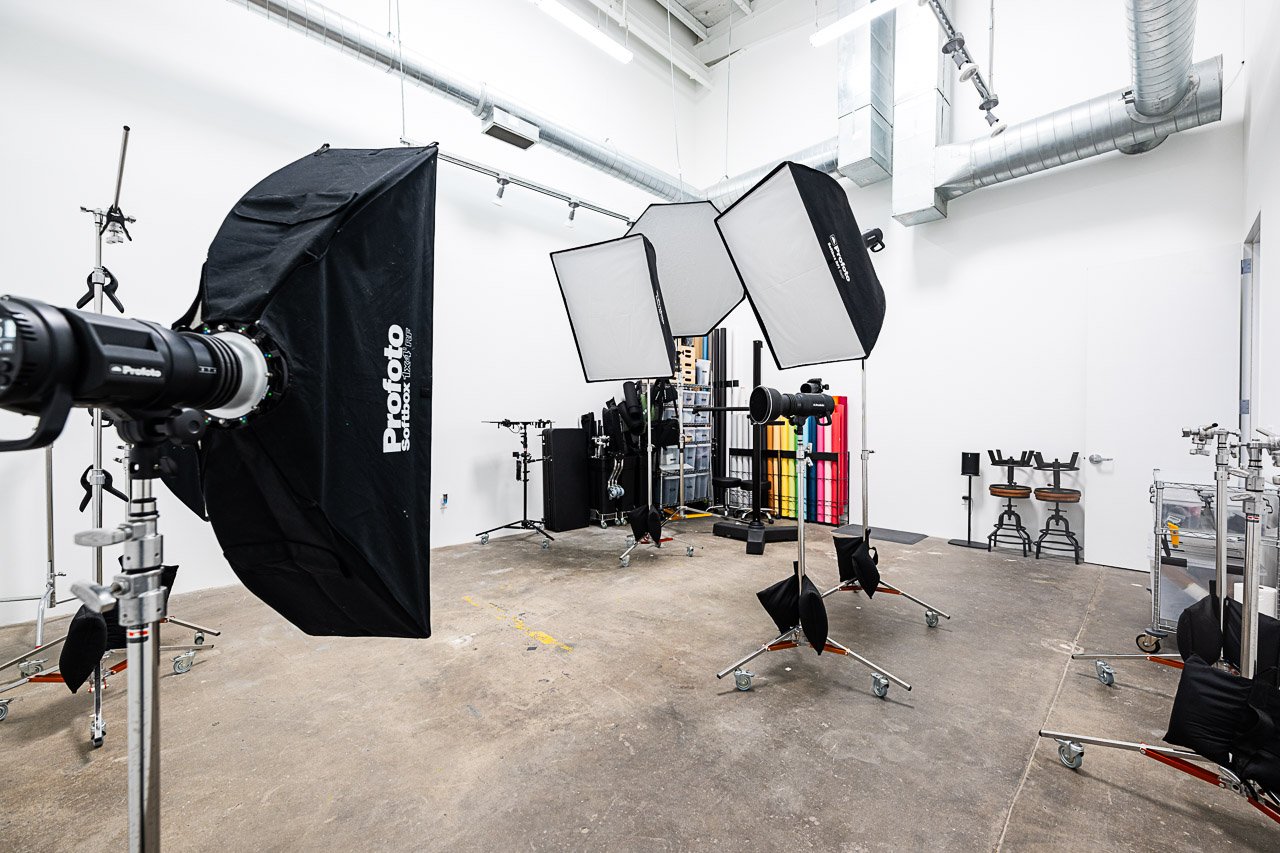
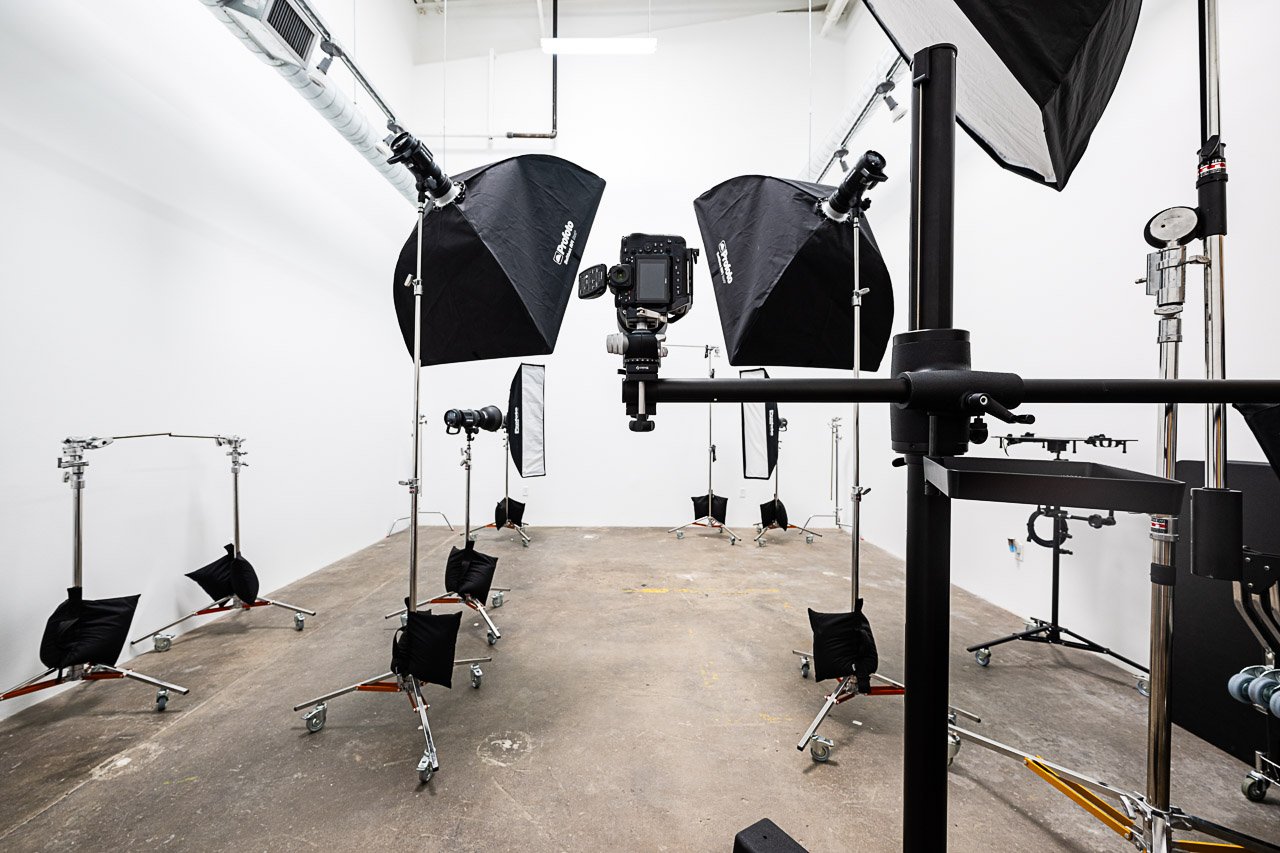
The floor of our studio is 3,960 square feet, the raised mezzanine deck is approximately 675 square feet, and the fenced patio outside our roll-up door is 1,650 square feet. To the peak of the ceiling / roof, our studio is 4 stories tall (unobstructed).

How much is your rent?

It’s not inexpensive to live and work in a space as large as our studio. Although this answer may not satisfy your curiosity, we’ve decided that this is how we’ll answer this frequently asked question (unless you’re our CPA).

Do you like living / working here?

There are certainly advantages and disadvantages to living and working in the Brewery. Some of the advantages include the creative atmosphere, the low cost per square foot, and the convenience of being located near downtown. From this area, we’re literally 30 minutes from almost everything Los Angeles has to offer. With our large studio, we have the space we need to work on any commercial, private, or personal photography project without being constrained by limitations often faced by other studios. We also really enjoy living and working within a historic building. Although it’s been a monumental task to put our space together like we’d envisioned, we’re proud to call ourselves residents of the Los Angeles Brewery.

What do you do in your studio?

We’re professional photographers. Within these walls we photograph a wide range of subjects including people, products, and food. We also use this space to meet with current and prospective clients as well as show and sell our fine art photography. As our location is a live / work studio, we also live in this space. Our bedroom is located on the raised mezzanine level. Some of our photographic specialties include wedding photography, individual and family portraits, food photography, product photography, corporate headshots, event photography, lifestyle photos for advertising, and fine art photography.

Rob Greer on Twitter

Sunday, June 21st, 2009

I’m not sure if I’ve come to grips with the whole “live life on Twitter” mentality, but I do have a Twitter account. So if you’re mad about Tweets, please consider following me on Twitter at http://www.twitter.com/robgreer/!

Los Angeles Photographer on Facebook

Friday, June 19th, 2009

If you haven’t already “friended” me on Facebook, I’d love to hear from you! And with my new username, I’m much easier to find. Since I live in Los Angeles and I’m a photographer, I chose los.angeles.photographer as my username. To friend me go to http://www.facebook.com/los.angeles.photographer!

Provisions Underground Wine Tasting Dinner

Saturday, June 6th, 2009

Tonight we had many guests in our Los Angeles photography studio for the Provisions Wine Tasting Dinner #2. Some of the items on the menu included several cheese platters; cut bread; grapes; strawberries; spanikopitas; yellow heirloom tomato gazpacho in shot glasses; a watermellon, heirloom tomato, and arugula feta cheese salad; orricchette with fresh peas, asparagus, and mint, and butter braised halibut with roasted vine tomatoes. As a photographer, I couldn’t help myself so I also took a few casual portraits of most of the guests (and I promised to post them on my blog). So here they are …

090606-185909-Edit

090606-190036-Edit

090606-190442-Edit

090606-190649-Edit

090606-190724-Edit


090606-193538-Edit

090606-193746-Edit

090606-193953-Edit

090606-194153-Edit

090606-194308-Edit

090606-194553-Edit

090606-194847-Edit

090606-183635-2-Edit

090606-191751-Edit

090606-195332-Edit

090606-195408-Edit 090606-195427-2-Edit

Choosing the Right L-Bracket | Kirk vs Really Right Stuff

Monday, April 27th, 2009

Editor’s Note: I’m publishing this article on my blog today because it was a very popular page on my old web site. Although this information is now almost 2-years old, you may find it helpful if you’re shopping for an L-bracket. I haven’t updated any other content in this article.

Choosing the Right L-Bracket

In days far past, when a photographer wanted to move a tripod mounted camera from landscape to portrait orientation, he or she would flip the camera to one side or another using capabilities present in most tripod heads. But flipping a camera using a tripod-mounted head can sometimes take precious time. It also means that the camera is no longer perfectly balanced on the top of the tripod causing the head to take more of the camera weight than is necessary. Also, depending on the size of the camera and the tripod being used, some photographers may find it difficult to achieve perfect 90-degree positioning. Finally, the photographer will likely need to recompose the scene after flipping the camera. Although you may think this particular problem is a trivial matter, reorienting a camera makes a big difference when taking photographs in the field under rapidly changing lighting conditions; every second counts.

With an L-bracket, photographers can change a camera’s orientation by removing camera from the tripod and remounting it on its opposite axis; no adjustments are required on the tripod head itself. This is accomplished using an L shaped Arca-Swiss style quick release plate, commonly referred to as an L-bracket.

There are many different brands of L-brackets available on the market today including products by Manfrotto and several generic import brands. However, most professional photographers agree that two of the best L-brackets are manufactured by Really Right Stuff (RRS) and Kirk Enterprises. With my recent purchase of a second Nikon D2x camera body, I felt it was a good time to compare the L-brackets provided by these two major superpowers of mounting technology.

For my last two camera bodies, the Nikon D70 and Nikon D2x, I had selected L-brackets from Kirk Enterprises. However, the Internet grapevine reported that Really Right Stuff (RRS) also manufactured excellent L-brackets. So, when I purchased a second Nikon D2x, I thought I would check the veracity of that claim. Taking this “chance” was also influenced by the fact that I had also recently purchased the Really Right Stuff B91-B flash arm. I found this product to be of very high quality and therefore assumed that I would not be disappointed with a RRS L-bracket.

This article is intended to provide you with my observations, as they relate to the Really Right Stuff BD2-L plate and the Kirk Enterprises BL-D2H L-bracket (hereafter referred to as L-brackets). These L-brackets are designed for the Nikon D2x. Both manufacturers also provide similar L-brackets designed for other camera bodies.

Port Accessibility

The Nikon D2x has data ports located on the left vertical edge of the camera. Both L-brackets provide an opening which allows access to these ports. However, the opening in vertical mount area on the RRS L-bracket is shallower than the opening on the Kirk L-bracket. Since some photographers find it difficult to open those rubber doors when an L-bracket is utilized, I believe that many photographers would find it easer to open those doors when using the RRS L-bracket. Really Right Stuff wins this category.

Mounting Options

The RRS L-bracket features lens axis marks engraved on the horizontal and vertical mounting areas, while the Kirk L-bracket does not have similar markings. Although some photographers might find this small detail trivial, I really like this feature. I find it particularly helpful when using other RRS components. My other RRS components also feature these axis marks. These marks can allow me to quickly and accurately align the RRS L-bracket to RRS tripod heads or flash arm mounts.

Both plates offer a 1/4″ hole on the L-bracket’s horizontal mounting area. For the RRS L-bracket, this hole is positioned directly over the lens axis. On the Kirk L-bracket, this hole is offset and not directly under the lens axis. This deficiency in the Kirk product could prove problematic if you sometimes mount your camera on plates that don’t feature an Arca-Swiss mount. This potential problem is most relevant for panoramic photographers where having an accurate axis point is particularly critical. Really Right Stuff wins this category.

Mounting Area

The horizontal Arca-Swiss mount area is approximately 55mm on the Kirk L-bracket while the RRS L-bracket boasts about 70mm of horizontal area. The vertical Arca-Swiss mount area is approximately 65mm on the Kirk L-bracket while the RRS L-bracket boasts about 70mm of horizontal area. Although I’m not certain that the extra surface area provided by the RRS L-bracket will prove more useful, I personally like the idea of a longer surface contact area for my 3 inch quick release plates. Really Right Stuff has the slight edge in this category.

Online Shopping

I purchase almost everything online. And although I do sometimes frequent my local store for last-minute purchases, I prefer to order online if I have the time to plan my purchases. For both the Kirk and RRS sites, the ordering process isn’t very pleasant. Kirk’s site features more intuitive, utilitarian navigation while the RRS site provides visitors with a more aesthetically pleasing presentation. But in both cases, neither site evokes a strong sense of trust. And both are sadly lacking in that they don’t accept American Express, my business credit card of choice. I believe that companies shouldn’t insert barriers to purchase; and the lack of support for any major credit card is a problem in my book. UPDATE (8/10/09): RRS now takes American Express.

Other General Observations

The RRS L-bracket is balanced so that the majority of the weight is centered on the horizontal plate. The Kirk L-bracket’s balance point is somewhere on the curve between the horizontal and vertical plate areas. In other words, when the RRS L-bracket is not mounted, its stands on its own while the Kirk plate falls onto its curved edge. Additionally, the RRS plate horizontal surface area is solid where it mounts to the camera. The Kirk plate is bored out and provides visibility to some areas of the camera bottom.

When measured on non-digital kitchen scale, both L-brackets appear to have the same weight. When working with a professional camera body like the Nikon D2x, I haven’t found the weight or additional bulk of either L-bracket noticeable.

The build quality on the L-brackets from both manufacturers is excellent. However, I feel that the RRS L-bracket seems to be more visually elegant than the Kirk L-bracket. Please note that this assessment is purely subjective and shouldn’t be weighted very heavily. I do maintain that I find both equally comfortable when taking photographs with my camera off-tripod.

Conclusions

Although the differences between the Really Right Stuff BD2-L plate and the Kirk Enterprises BL-D2H L-bracket are minor, I’d have to give the slight edge to the Really Right Stuff BD2-L plate. If you’re already the happy owner of a Kirk Enterprises BL-D2H L-bracket, don’t despair. You have a great product. I plan to continue using my Kirk L-bracket on my backup D2x and mount the RRS L-bracket on my primary D2x. But if you don’t yet own an L-bracket, I’d have to point you to the folks at Really Right Stuff for an overall superior product.

As of this writing, the Really Right Stuff BD2-L plate is $183.00 with $9.15 for UPS ground shipping and the Kirk Enterprises BL-D2H L-bracket is priced at $179.95 with $7.60 for UPS ground shipping. These are steep prices for such a simple accessory, but for my style of photography, I can’t imagine taking tripod-mounted photographs using any other similarly performing product.

Studio Party Photos – Photobooth

Tuesday, March 31st, 2009

We had a little party for friends and clients this weekend so I set up a photo booth area. I wish I had more photos of our guests! To be honest, I’m sure a lot more people wanted photos but I think I was too busy saying hello to everyone and no one wanted to drag me away to take their photos. Anyway … no more excuses. Here are a few photobooth photos. For all of the party photos click here.

  090329-152039 090329-155753 090329-170120 090329-211156090329-170420-Edit 090329-170834 090329-170957 090329-171345 090329-175746 090329-175844-Edit 090329-180047-Edit 090329-180218-Edit 090329-203027 090329-203438 090329-203620 090329-204207 090329-204454 090329-205500 090329-210941

Clive Cussler’s Corsair is Published – Author Portrait

Sunday, March 29th, 2009

I was in Costco yesterday (buying some new tires) and saw that Clive Cussler’s latest novel, Corsair, has just been released. I’m happy to announce that G. P. Putnam and Sons has yet again printed one of my portraits of Clive on the back of the dust jacket. This particular portrait of Clive Cussler also appears on the back covers of The Chase and Plague Ship. Corsair is co-authored with Jack DuBrul (who is also one hell of a nice guy) and continues the Oregon Files saga. Since Clive remains one of my favorite authors (an author among authors), I always feel honored when my photos appear on the back of his novels.

Untitled-1-copy 060225-0935302

Omnicom Group Fails Photographers

Thursday, March 19th, 2009

The Omnicom Group is the world’s largest advertising agency holding company. Apparently they’ve decided to change their policy in regards to how photographers are paid for commercial projects. As a working photographer, I’d be unable to support these terms. Here’s a media alert sent out by the American Society of Media Photographers:

Omnicom Passes the Buck

It has been brought to the attention of the American Society of Media Photographers (ASMP) that the Omnicom Group, the world’s largest advertising agency holding company, has changed its terms and conditions in an effort to limit their agency liability and in so doing transfer that liability to independent photographers and producers. Basically, by disclosing their agency status and for whom they are acting, the advertising agency is only liable to the extent that their client has specifically paid them for any amounts payable to you. Additionally, ASMP has been informed that reps are being told that there will no longer be any advances on assignments.

These new policies are most probably the result of the market and governmental pressures experienced by major corporate clients such as GM who in their effort to avoid bankruptcy are now prioritizing their financial obligations and will make payment according to those priorities. In other words, some suppliers will be waiting significantly longer to be paid depending upon the client’s priorities. That being the case, agencies do not want to be left on the hook for reimbursement of monies expended on behalf of their clients, especially where the fear of bankruptcy exists.

These terms and conditions are simply not in the best interests of photographers, producers or clients. This action, clearly taken in anticipation of increasingly difficult financial conditions is a unilateral effort to shift the burden onto those who are least prepared to bear it. Should an independent photographer of moderate means be the banker for a Fortune 100 company? By eliminating their customary role as intermediate financier, agencies are removing value from the value-added chain, and that will ultimately lead to an overall dampening effect on commerce.

Meanwhile, there is no incentive for the agencies to make photographer friendly changes to their terms and conditions as long as photographers are willing to accept the current terms. Notice of these changes should be included in your blogs and discussed on related lists and social networking sites. The issue needs to become viral and requires significant support from key photographers in order to gain traction and effect change. If it is business as usual for the agencies, then nothing will be accomplished.

ASMP would recommend that photographers include in their paperwork a statement making it clear that there will be no grant of copyright license until all related assignment invoices are paid in full. Images should be registered with the Copyright Office immediately upon completion of the shoot and prior to first publication and/or possible infringement so that in the event that legal action – a last resort – is needed, recovery of statutory damages and court costs will be possible.

In addition, the Association of Independent Commercial Producers (AICP) recommends the following:

“If an agency’s internal policy insists upon these payment terms (sequential liability), the production company should:

a) Make sure the advertiser (“client”) also signs this agreement. If it is a rider, the terms of payment and the full contract price should be added to the rider.

b) Be provided with the advertiser billing and contact information.

c) Copy the advertiser on all invoices.

d) Notify the advertiser of payment due as soon as terms of the contract (payment dates) are not met by the agency.”

As a possible course of action, since the agencies are shifting liability to their corporate clients, perhaps photographers should consider approaching the clients directly for advances and or other payments prior to the beginning of the assignment.

Ultimately, this is a case of the supplier beware!

Eugene Mopsik

Executive Director, ASMP

mopsik@asmp.org